3D City Model
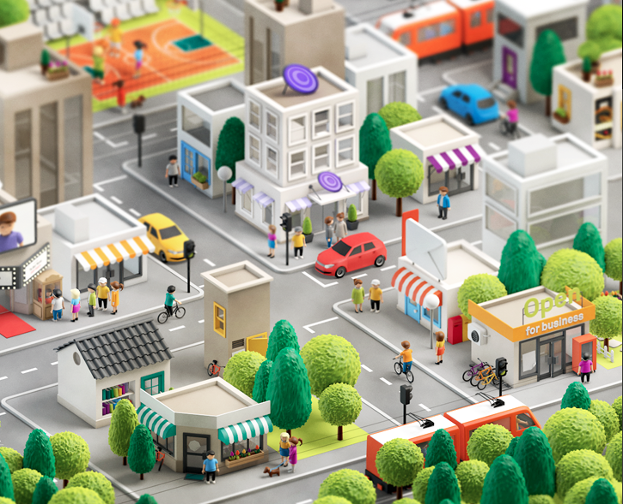
Objective:
To design a 3D city model using mathematical concepts.
To identify and use 3D shapes in real-life structures.
To apply measurement and area while planning the city layout.
To show patterns and symmetry in city design.
To explain how maths is used in real life.
Project Information:
A 3D city model showing the use of maths concepts such as shapes, measurement, area, patterns, and numbers in real-life city planning.
Outcome: Demonstrates how maths is applied in designing and planning a city.
Real-Life Application
Used in city and town planning
Helps design buildings, roads, and parks
Used by architects and engineers
Helps manage space and measurement
Shows how maths is used in everyday life
Triangles to Squares Travel Game

Objective of the project: Understand shapes (triangles and squares) and how smaller shapes can combine to form larger ones.
- Develop logical thinking, spatial awareness, and teamwork.
- Begin recognizing fractions as parts of a whole (½, ¾, 1).
Project Information: Shuffle all pieces face down in a pile.
- Each player draws three pieces.
- Player starts by placing one piece in the center.
- Each player, in turn, adds a piece that matches the color and
connects properly.
- When a player completes a full square of one color, they score one point.
- Completing two squares at once earns two points.
- Keep score using tally marks — the player with the most points wins!
Optional: Players may move one existing piece instead of adding a new one during their
turn.
Real-life application:Understand shapes (triangles and squares) and how smaller shapes can
combine to form larger ones.
- Develop logical thinking, spatial awareness, and teamwork.
- Begin recognizing fractions as parts of a whole (½, ¾, 1).
Helps children understand how parts form a whole — a foundation for geometry and fractions.
• Develops problem-solving and visual reasoning skills.
• Mirrors real-world construction, art, and design thinking
(e.g., arranging tiles or patterns)
Addition and Subtraction Ice Cream Store

Objective of the project:
● To understand the basic concepts of addition and subtraction within 1–20 through hands-on activities.
● To use popsicle sticks as counting tools to visually represent adding and taking away numbers.
● To help students learn how addition means putting together and subtraction means taking away.
● To encourage critical thinking and problem-solving skills by solving simple addition and subtraction problems.
Project Information:
How it works: Students set up an Addition and Subtraction Store and use popsicle sticks to count, add, and take away numbers within 1–20. By role-playing as shopkeepers and customers, they solve math problems using hands-on counting.
Real-life application: This activity helps students understand how addition and subtraction are used in daily life, such as buying items, sharing things, and counting money or objects accurately
Brainworks-Total School is hosting its 22nd Annual Science, STEAM, ICT, and Math Fair, an engaging and educational event that showcases the enthusiasm and creativity of students in these diverse fields. This exciting platform brings together projects that highlight innovation across Science, Technology, Engineering, Arts, and Mathematics, as well as cutting-edge developments in AI and robotics.
The Science, STEAM, ICT, and Math Fair 2025 celebrates the wonders of scientific discovery, technological advancement, and creativity.
This year, a special focus will be placed on AI projects, showcasing the transformative role of artificial intelligence in fields such as robotics, machine learning, and data science. Students will demonstrate AI-driven innovations, from autonomous robots to AI-powered vision systems, offering a glimpse into the future of technology.
Through these projects, students will not only hone their scientific and critical thinking skills but also explore how AI can help solve 21st-century sustainability challenges. The fair fosters global collaboration and encourages students to take on the responsibilities of shaping a future driven by technology and innovation.