EcoVille: A Sustainable City
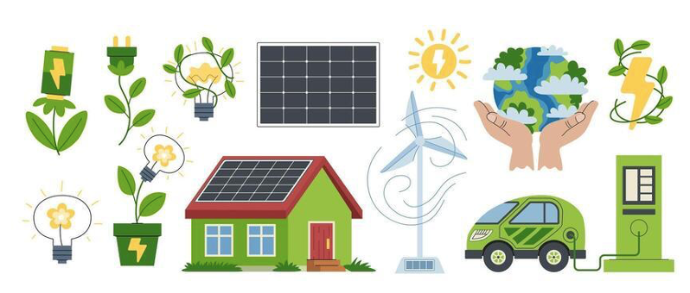
Objective of the project:
● To understand the concept of sustainability and how cities can be designed to be environmentally friendly.
● To explore renewable energy, waste management, water conservation, and green architecture.
● To develop critical thinking, creativity, and problem-solving skills through city planning simulations.
Project Information:
How it works: Students design and build a model of a city that incorporates sustainable practices, such as solar panels, rainwater harvesting, recycling systems, green spaces, and energy-efficient buildings.
Real-life application: Promotes awareness of climate change, sustainable living, and eco-friendly urban planning. Real-world relevance includes green city projects, renewable energy solutions, and environmental conservation efforts.
Types of Energy
Objective of the project:
● To help students understand different types of energy through hands-on experiments and recognize how energy is used in everyday life.
● To develop students’ scientific inquiry and communication skills by encouraging them to observe, explain, and present basic energy concepts through hands-on learning.
Project Information:
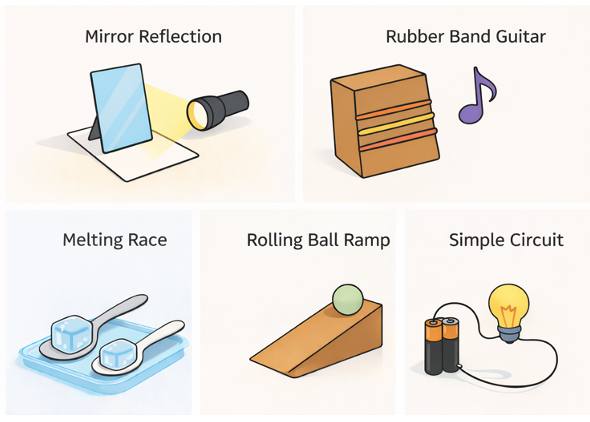
How it works: Students explore five simple experiments that demonstrate light, sound, heat, kinetic, and electrical energy by observing reflection, vibration, melting, movement, and electric circuits.
Real-life application: This project builds awareness of how energy supports daily activities such as lighting homes, communication, cooking, transportation, and using electrical devices, connecting classroom learning to real-world experiences
Germination in a Bag
Objective of the Project:
● To help students understand the process of seed germination through hands-on observation and simple experimentation without using soil.
● To develop students’ scientific inquiry and communication skills by encouraging them to observe, describe, and present how seeds grow into plants using a simple hands-on activity.
Project Information:
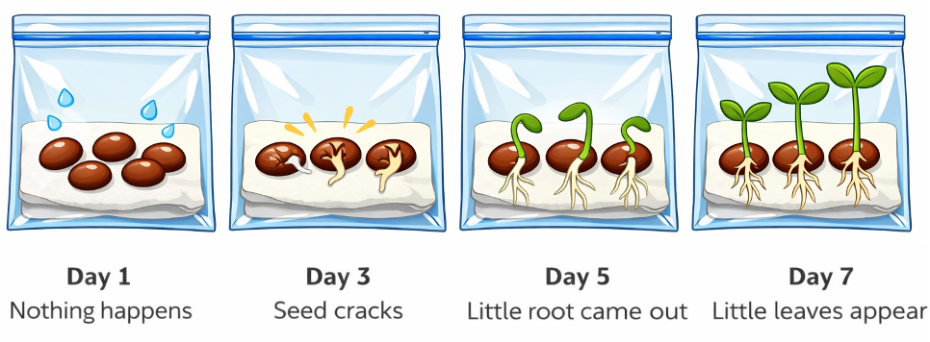
How it works: Students place seeds on moist tissue inside a clear plastic bag and observe the changes each day. Without using soil, students can clearly see how water and air help the seed sprout roots, shoots, and leaves over time.
Real-life application: Helps students understand how plants begin to grow and why water, air, and proper care are important for food production and gardening. This knowledge is useful in real life for farming, home gardening, plant care, and environmental awareness
Habitopia
Objective of the project:
● To understand what a habitat is and how animals depend on their environment for food, water, shelter, and safety.
● To identify and compare forest, desert, ocean, grassland, arctic, and wetland habitats using visual and interactive learning.
● To develop thinking and decision-making skills by observing, choosing, and discussing scientific ideas.
Project Information:
How it works: This project presents six animal habitats on a wooden turntable display stand, created using pictures and craft materials. Each habitat shows natural features and animals that help explain how living things survive in different environments.
Real-life application: This project helps students understand where animals live and how their environments support survival. It also encourages students to notice habitats around them and care for nature in simple, everyday ways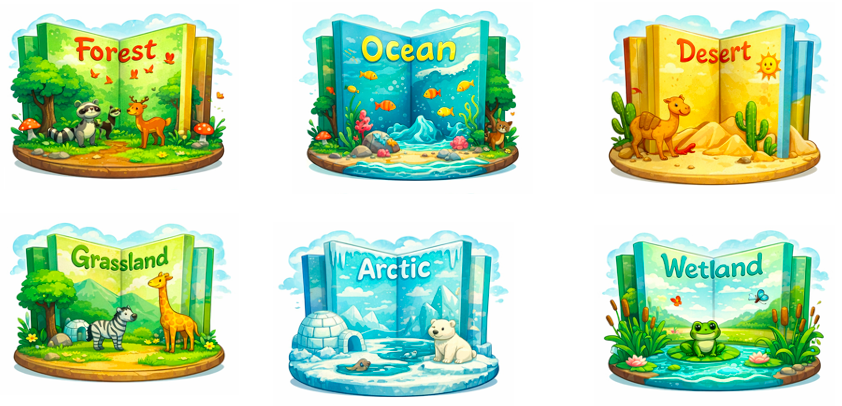
Photosynthesis Life Model
Objective of the Project
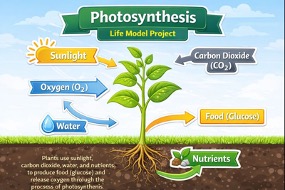
To help students understand how plants make their own food through the process of photosynthesis by using a simple, hands-on life model.
To develop students’ scientific observation and communication skills by encouraging them to identify, explain, and present the basic needs of plants and the steps involved in photosynthesis through visual and hands-on learning.
Project Information
How it works: Students create a photosynthesis life model that shows how plants use sunlight, water, carbon dioxide, and nutrients to make food. The model includes key parts such as the sun, leaves, roots, soil, and air, with arrows and labels to demonstrate how inputs enter the plant and how oxygen is released. Students observe the process and explain it in simple terms.
Real-life application: This project helps students understand the importance of plants in everyday life. Students learn that photosynthesis provides food for plants, produces oxygen for humans and animals to breathe, and supports life on Earth. By connecting the model to real-life examples such as trees, crops, and gardens, students see how photosynthesis is essential for a healthy environment and daily living.
Phases of Moon
Objective of the project
To understand the concept of the Moon’s phases and how the Moon’s position changes as it orbits the Earth.
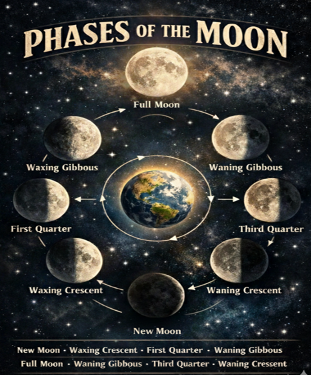
To explore the eight phases of the Moon and learn how sunlight causes the Moon to appear in different shapes.
To develop observation, critical thinking, and scientific reasoning skills by predicting and modeling the Moon’s phases.
How it works
This project helps students understand how the Moon orbits the Earth and reflects the Sun’s light. By using models, students observe how sunlight falls on different parts of the Moon, creating the eight phases of the Moon we see from Earth. As the Moon moves around the Earth, its visible shape changes in a repeating cycle.
Real Life Application
Many traditional calendars are based on the Moon’s phases, helping people track months.
The Moon’s phases affect tides, which is important for fishermen, sailors, and coastal communities.
Understanding the Moon phases helps astronomers and space missions plan observations and travels.
Students can predict how the Moon will look each night.
Some festivals and holidays are scheduled according to the Moon’s phases.
Lava Lamp
Objective of the project
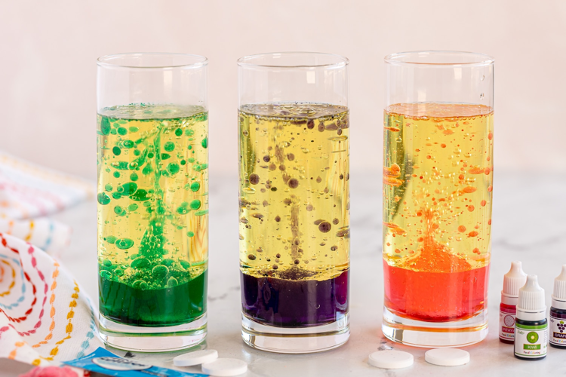
Students will explore chemical reactions and density by observing how gas bubbles cause colored water to rise and sink in an oil-and-water mixture.
Project information
How it works : When vinegar and baking soda are added, they react and produce carbon dioxide gas. The gas forms bubbles that attach to the colored water and lift it up through the oil.
When the bubbles reach the top, the gas escapes into the air. The water then becomes heavier and sinks back down.
This rising and sinking movement keeps repeating, creating the lava lamp effect. A lava lamp works because oil and water do not mix, and they have different densities.
Oil is lighter, so it stays on top of the water.
Real-life application : This experiment helps us understand gas formation and density — how liquids and gases behave differently. These ideas are used in things like fizzy drinks, baking bread, and even in science experiments that study how gases move
Brainworks-Taunggyi School is hosting its 22nd Annual Science, STEAM, ICT, and Math Fair, an engaging and educational event that showcases the enthusiasm and creativity of students in these diverse fields. This exciting platform brings together projects that highlight innovation across Science, Technology, Engineering, Arts, and Mathematics, as well as cutting-edge developments in AI and robotics.
The Science, STEAM, ICT, and Math Fair 2025 celebrates the wonders of scientific discovery, technological advancement, and creativity.
This year, a special focus will be placed on AI projects, showcasing the transformative role of artificial intelligence in fields such as robotics, machine learning, and data science. Students will demonstrate AI-driven innovations, from autonomous robots to AI-powered vision systems, offering a glimpse into the future of technology.
Through these projects, students will not only hone their scientific and critical thinking skills but also explore how AI can help solve 21st-century sustainability challenges. The fair fosters global collaboration and encourages students to take on the responsibilities of shaping a future driven by technology and innovation.